
When you check your water with a TDS meter and see a reading like 25 ppm, it can be confusing. Many people assume that lower TDS means better water—but that’s not always true.
So, is 25 TDS safe for drinking water? The short answer is: it is generally safe, but not ideal for long-term daily use.
Let’s understand this in detail in simple, practical terms.
What Does 25 TDS Mean?
TDS (Total Dissolved Solids) measures the amount of dissolved substances in water.
👉 If your water shows 25 ppm TDS, it means:
- Only 25 mg of dissolved solids are present in 1 litre of water
- The water is extremely low in minerals
This usually happens with:
- RO (Reverse Osmosis) water
- Distilled or highly purified water
Is 25 TDS Safe for Drinking?
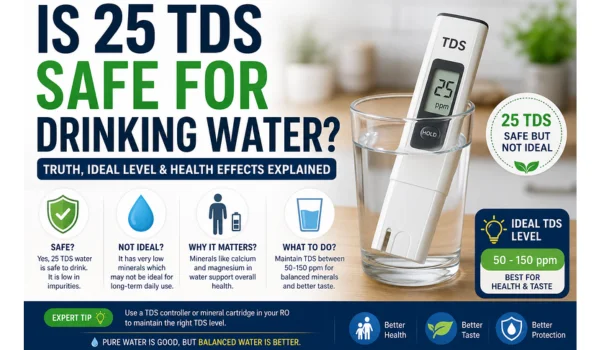
✔️ Yes, It is Safe (Short Answer)
Water with 25 TDS is:
- Free from most impurities
- Low in harmful contaminants
- Generally safe for short-term consumption
However…
⚠️ Not Ideal for Daily Long-Term Use
Drinking very low TDS water regularly may not be the best choice because it lacks essential minerals.
Why Low TDS Can Be a Problem
Water is not just for hydration—it also provides small but important amounts of minerals like:
- Calcium
- Magnesium
- Potassium
At 25 TDS, these minerals are almost absent.
Possible Issues Over Time:
- Mineral deficiency (if your diet is also low)
- Flat or tasteless drinking experience
- Reduced electrolyte intake
According to guidance from the World Health Organization, very low mineral content in water may not be ideal for regular consumption.
Ideal TDS Level for Drinking Water
For Indian households, the recommended range is:
- 50–150 ppm → Ideal
- 150–300 ppm → Acceptable
- Below 50 ppm → Too low (not ideal)
👉 So, 25 TDS falls below the ideal range.
Taste Difference: Why 25 TDS Feels “Flat”
Have you ever noticed RO water sometimes tastes “empty” or “bland”?
That’s because:
- Minerals add a natural taste to water
- At 25 TDS, water lacks this taste
Taste Comparison:
- 25 ppm → Flat, neutral
- 80–120 ppm → Fresh, slightly sweet
- 300+ ppm → Salty or bitter
When is 25 TDS Water Acceptable?
There are situations where 25 TDS water is perfectly fine:
✔️ During Travel or Short-Term Use
Safe for a few days or weeks
✔️ If Your Diet is Mineral-Rich
If you consume enough minerals from:
- Milk
- Fruits and vegetables
- Nuts
✔️ In Areas with Highly Contaminated Water
RO systems reduce TDS drastically to remove harmful substances
When Should You Avoid 25 TDS Water?
❌ For Long-Term Daily Drinking
Especially if:
- Your diet lacks nutrients
- You depend heavily on water for mineral intake
❌ For Children and Elderly
They may need balanced mineral intake
❌ If You Feel Weakness or Taste Issues
Sometimes people report:
- Fatigue
- Unpleasant taste
RO Water and 25 TDS: What’s Happening?
Most Indian homes using RO purifiers face this issue.
Why RO Produces Very Low TDS
RO filters remove:
- Dissolved salts
- Heavy metals
- Chemicals
This can reduce TDS to:
- 10–30 ppm
Is This Good or Bad?
- Good → Removes harmful contaminants
- Not ideal → Removes beneficial minerals too
How to Increase TDS from 25 to Ideal Levels
If your water is at 25 TDS, you can easily improve it.
- Use a TDS Controller
Modern RO systems allow you to adjust TDS levels.
👉 Set it to 80–120 ppm for best results.
- Add a Mineral Cartridge
This adds back essential minerals like calcium and magnesium.
- Mix RO Water with Raw Water
Some systems blend purified and untreated water to balance TDS.
- Choose Advanced RO Systems
Look for:
- “Mineral RO”
- “Copper RO”
- “Alkaline RO”
Comparison: 25 TDS vs Ideal TDS
| Feature | 25 TDS Water | Ideal TDS (80–150) |
| Safety | Safe | Safe |
| Minerals | Very low | Balanced |
| Taste | Flat | Pleasant |
| Long-term use | Not ideal | Recommended |
| Health support | Limited | Better |
Health Perspective: Should You Worry?
Let’s be practical.
✔️ If You Drink 25 TDS Occasionally
No problem at all.
⚠️ If You Drink It Daily for Years
- May not provide mineral benefits
- Depends on your diet
👉 Important point:
Most nutrients come from food, not water—but water still contributes.
Common Myths About Low TDS Water
Myth 1: Lower TDS Means Better Water
❌ Not always. Extremely low TDS is not ideal.
Myth 2: RO Water is Always Perfect
❌ RO needs proper TDS adjustment.
Myth 3: 25 TDS is Dangerous
❌ It is safe, just not optimal.
How to Check Your Water TDS
You can easily monitor this at home.
Use a TDS Meter
- Cost: ₹150–₹500
- Gives instant reading
Steps:
- Fill a glass with water
- Insert the meter
- Read the value
Practical Advice for Indian Households
If your water shows 25 TDS, here’s what you should do:
- ✔️ Don’t panic—it’s safe
- ✔️ Improve it to 80–120 ppm if possible
- ✔️ Ensure a balanced diet
- ✔️ Maintain your RO purifier regularly
FAQs
- Is 25 TDS water safe to drink daily?
Yes, but it is not ideal for long-term use due to lack of minerals.
- What is the best TDS level for drinking water?
50–150 ppm is considered ideal.
- Can low TDS water cause health problems?
Not directly, but long-term use may reduce mineral intake.
- Why does my RO water show 25 TDS?
Because RO removes almost all dissolved solids, including minerals.
- Should I increase my RO water TDS?
Yes, adjusting it to 80–120 ppm is recommended.
- Is 0–30 TDS water harmful?
No, it is safe—but not the best choice for daily consumption.
Final Verdict
So, is 25 TDS safe for drinking water?
👉 Yes, it is safe—but not ideal.
For the best health and taste:
- Avoid extremely low TDS for daily use
- Maintain a balanced range (50–150 ppm)
- Use RO wisely with mineral adjustment
In simple words, pure water is good—but balanced water is better.