
Insurance can protect individuals and families from financial losses caused by events such as illness, accidents, property damage, death or other unexpected situations. However, insurance policies often contain technical terms that can be difficult to understand for first-time buyers.
Knowing the meaning of common insurance terms can help Indian policyholders compare policies, understand their coverage and avoid confusion when making a claim. Whether you have health insurance, life insurance, motor insurance or general insurance, understanding the basic terminology is useful.
Policyholder
The policyholder is the person who purchases the insurance policy and enters into an insurance contract with the insurer.
The policyholder is generally responsible for paying the premium and providing the information required by the insurer. Depending on the type of policy, the policyholder and the insured person may be the same or different.
Insurer
The insurer is the insurance company that provides insurance coverage under the policy.
The insurer collects premiums and agrees to provide benefits or compensation for covered events according to the policy terms, conditions, exclusions and applicable regulations.
Insured
The insured is the person, property or interest that is protected by the insurance policy.
For example, in health insurance, the insured may be an individual or family members covered under the policy. In motor insurance, the insured interest may relate to the insured vehicle and associated risks.
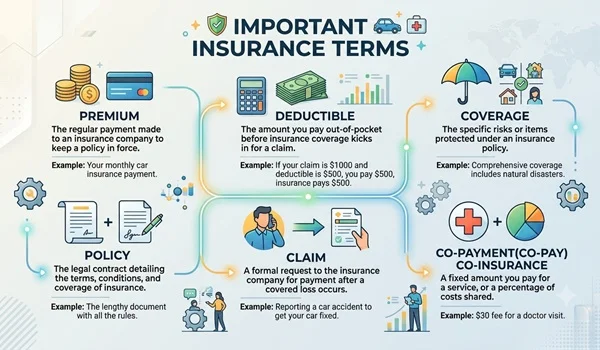
Premium
The premium is the amount paid to keep an insurance policy active.
Depending on the policy, premiums may be paid monthly, quarterly, annually or according to another permitted payment schedule.
Premiums can vary based on factors such as age, coverage amount, policy type, location, risk profile and selected benefits.
Sum Insured
The sum insured is the maximum amount an insurer may pay for covered losses under an insurance policy, subject to the policy’s terms and conditions.
This term is commonly used in health and general insurance.
For example, a health insurance policy may have a specified sum insured that can be used toward eligible medical expenses during the policy period.
Sum Assured
Sum assured is commonly used in life insurance and refers to the amount specified as the insurance benefit under the policy, subject to its terms.
Although “sum insured” and “sum assured” sound similar, they are generally used in different insurance contexts.
Policy Term
The policy term is the period for which insurance coverage is provided.
For example, a policy may provide coverage for one year or, depending on the product, for a much longer period.
Policyholders should know the start date and end date of their coverage and understand the renewal requirements.
Policy Schedule
The policy schedule is a document containing important details about the particular insurance policy.
It may include information such as:
- Policy number
- Policyholder’s name
- Insured members or property
- Coverage amount
- Premium
- Policy period
- Applicable add-ons or benefits
It is useful to keep the policy schedule safely accessible.
Claim
A claim is a request made by the policyholder or beneficiary to the insurer for payment or benefits arising from an event covered under the policy.
The insurer reviews the claim against the policy terms and supporting documents before deciding the applicable benefit or settlement.
Claim Settlement
Claim settlement refers to the process through which an insurer assesses and pays an admissible claim according to the policy.
The amount payable can depend on coverage limits, deductibles, exclusions, waiting periods and other applicable conditions.
Deductible
A deductible is the amount that the policyholder is required to bear before the insurer becomes responsible for the applicable portion of a covered loss.
Deductibles are common in several types of insurance, including motor and general insurance.
A higher deductible may sometimes reduce the premium, but it also means a greater amount has to be paid by the policyholder when a claim occurs.
Co-Payment
A co-payment, or co-pay, means the policyholder has to pay a specified portion of an eligible claim while the insurer pays the remaining applicable portion.
This term is particularly important in health insurance.
For example, if a policy contains a 20% co-payment condition, the policyholder may have to bear 20% of the admissible claim, subject to the policy’s exact wording.
Waiting Period
A waiting period is a specified period during which certain coverage or benefits are not available.
Health insurance policies may contain waiting periods for pre-existing diseases, particular treatments or other specified conditions.
Understanding waiting periods before purchasing a policy is important because they can affect when particular benefits become available.
Pre-Existing Disease
In health insurance, a pre-existing disease generally refers to a medical condition that existed before the policy began, as defined under the applicable policy terms.
Such conditions may be subject to a waiting period or other conditions.
Policyholders should disclose relevant medical information honestly when applying for health insurance.
Exclusions
Exclusions are situations, treatments, losses or expenses that are not covered by an insurance policy.
Every policy has its own exclusions. These can significantly affect the amount that can be claimed.
Before purchasing insurance, policyholders should read the exclusions section rather than assuming that every possible loss is covered.
Grace Period
A grace period is an additional period allowed for paying a premium after the original premium due date, subject to the policy terms.
Coverage during a grace period can depend on the type of insurance and applicable conditions. Policyholders should avoid relying on the grace period and should try to pay premiums on time.
Renewal
Renewal means continuing an insurance policy for another period after the current policy term ends.
Renewal terms vary according to the type of policy and applicable regulations. Policyholders should check renewal dates carefully to avoid an unintended break in coverage.
Lapse
A policy may lapse when required premium payments are not made within the applicable period and the policy’s coverage or benefits cease according to its terms.
The consequences of a lapse depend on the insurance product and policy conditions.
Nominee
A nominee is a person named by the policyholder to receive the applicable policy proceeds or benefits in circumstances specified by the policy and applicable law.
Nomination is particularly important in life insurance because it helps provide clarity about whom the insurer should deal with when the policyholder dies.
Beneficiary
A beneficiary is a person or entity entitled to receive a benefit under an insurance policy.
The exact legal meaning and rights of beneficiaries can vary depending on the type of insurance and applicable law.
Rider or Add-On
A rider or add-on is an additional feature or coverage that can be attached to an insurance policy, subject to the insurer’s terms.
Examples may include additional accident-related coverage, specific health benefits or other optional protections.
Additional benefits generally come with additional costs or conditions, so policyholders should assess whether they are actually useful.
No-Claim Bonus
A No-Claim Bonus, commonly called NCB, is a benefit offered under certain insurance policies when eligible claims are not made during the applicable policy period.
NCB is particularly familiar in motor insurance, where it may provide a discount on the own-damage portion of the premium, subject to applicable terms.
Cashless Treatment
Cashless treatment is a facility commonly associated with health insurance. At an eligible network hospital, the insurer or claims administrator may settle approved covered expenses directly with the hospital, subject to policy conditions and authorisation.
Cashless does not necessarily mean that every hospital expense becomes free. Non-covered expenses, deductibles, co-payments and other amounts may still need to be paid by the insured.
Network Hospital
A network hospital is a hospital that has an arrangement with an insurer or its claims administrator for providing eligible cashless healthcare services under applicable conditions.
Before planned hospitalisation, policyholders should check whether their preferred hospital is currently part of the relevant network.
Reimbursement Claim
A reimbursement claim is a claim in which the policyholder initially pays eligible expenses and later submits the required documents to the insurer for reimbursement, subject to policy terms.
This can be relevant when treatment is received at a facility where cashless service is not available or not used.
Insurable Interest
Insurable interest means a legitimate financial or other recognised interest in the subject being insured, such that the policyholder would face a loss if the insured event occurred.
It is a fundamental concept in insurance and helps establish the basis for an insurance contract.
Underwriting
Underwriting is the process used by an insurer to assess risk before issuing or modifying an insurance policy.
Depending on the type of insurance, the insurer may consider factors such as age, health information, occupation, vehicle details, property characteristics and other relevant risk factors.
The underwriting process can influence eligibility, premium and policy terms.
Disclosure
Disclosure means providing relevant and accurate information requested by the insurer when applying for insurance.
For example, a health insurance applicant may need to provide information about existing medical conditions.
Incomplete or inaccurate information can create problems later, particularly during claim assessment.
Proposal Form
A proposal form is the application submitted to an insurer when seeking insurance coverage.
It contains information that the insurer uses to assess the proposed risk and determine applicable terms.
Applicants should read their answers carefully and ensure that the information provided is accurate.
Policy Exclusions vs Policy Limits
These two concepts are often confused.
A policy exclusion means a particular event, treatment or expense is outside the scope of coverage.
A policy limit means the item may be covered, but only up to a specified amount or subject to a specified restriction.
Understanding the difference can help policyholders estimate their potential out-of-pocket expenses.
Why Understanding Insurance Terms Matters
Insurance policies are contracts, so the exact wording matters. A policyholder who understands basic terminology is better positioned to compare plans and ask meaningful questions before purchasing coverage.
Before buying or renewing insurance, check:
- What is covered?
- What is excluded?
- How much coverage is available?
- What waiting periods apply?
- Is there a deductible or co-payment?
- What are the policy limits?
- How are claims submitted?
- When does the policy expire?
- What are the renewal conditions?
Final Thoughts
Insurance terminology can initially appear complicated, but understanding a few important terms makes policies much easier to evaluate. Terms such as premium, sum insured, sum assured, deductible, co-payment, waiting period, exclusion, claim, nominee, renewal and underwriting are especially useful for Indian policyholders to understand.
Rather than choosing an insurance policy only on the basis of premium, read the coverage, exclusions, limits and conditions carefully. If any important clause is unclear, seek clarification from the insurer or a qualified insurance professional before making a purchase.