
Opening a demat account may be free with many brokers, but that does not mean you will never pay any charges. Investors can incur different costs for maintaining the account, buying and selling securities, transferring shares, pledging securities and using certain services.
The most common charges include Annual Maintenance Charges (AMC), brokerage, DP charges, transaction charges and statutory taxes and fees.
Understanding these costs is important because a demat account that advertises zero account-opening charges may still have other fees.
What Are Demat Account Charges?
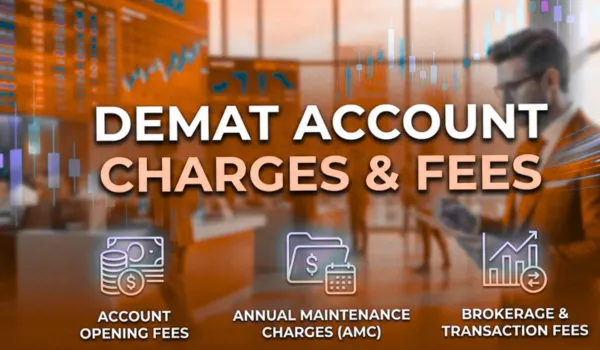
Demat account charges are fees associated with maintaining and using an account that holds securities such as shares, bonds, ETFs and other eligible investments in electronic form.
A demat account is maintained through a Depository Participant (DP) connected with a depository such as NSDL or CDSL.
NSDL explains that it charges its Participants rather than directly charging investors. The DP then determines the charges applicable to its clients according to its tariff structure.
The charges you may encounter include:
- Account opening charges
- Annual Maintenance Charges
- Brokerage
- DP charges
- Dematerialisation charges
- Rematerialisation charges
- Pledge and unpledge charges
- Transaction-related charges
- GST
- Securities Transaction Tax
- Exchange and regulatory charges
- Other service charges
Not every investor will pay all of these charges.
Main Demat Account Charges at a Glance
| Charge | What It Means | When It May Apply |
| Account opening fee | Cost of opening the account | At account opening, if applicable |
| AMC | Annual cost of maintaining the demat account | Every year or as per billing cycle |
| Brokerage | Fee charged for executing trades | When buying or selling securities |
| DP charge | Depository transaction charge passed on by the DP | Usually when securities are debited |
| STT | Government tax on specified securities transactions | On applicable transactions |
| GST | Tax on applicable services and charges | Along with taxable charges |
| Exchange charges | Charges related to exchange transactions | On applicable trades |
| Pledge charges | Cost of pledging securities | When securities are pledged |
| Demat charges | Cost of converting physical securities into electronic form | When dematerialisation is requested |
| Remat charges | Cost of converting electronic securities back to physical form | When applicable |
- Annual Maintenance Charges (AMC)
Annual Maintenance Charges, commonly called AMC, are fees charged for maintaining a demat account.
Some brokers charge a fixed annual amount, while others may offer:
- ₹0 AMC
- First-year AMC waiver
- Quarterly AMC
- Different AMC for BSDA and regular accounts
- AMC based on the selected brokerage plan
Therefore, “free demat account” does not necessarily mean that the account will remain completely free.
Is AMC Charged Even If You Do Not Trade?
It depends on the broker’s tariff.
AMC is generally associated with maintaining the demat account rather than the number of trades you execute. Therefore, an account can have maintenance charges even if you do not actively buy or sell securities.
Some brokers, however, offer zero AMC plans.
Always check the current tariff before opening an account.
- Brokerage Charges
Brokerage is the fee charged for executing a buy or sell order.
The amount can depend on:
- Type of security
- Delivery or intraday trading
- Futures and options
- Brokerage plan
- Order value
- Broker
For example, a broker may charge a percentage of the transaction value for equity delivery, while another may charge a flat amount per executed order.
Example of Percentage-Based Brokerage
Suppose a broker charges 0.1% brokerage and you purchase shares worth ₹50,000.
Brokerage would be:
₹50,000 × 0.1% = ₹50
If the broker charges ₹20 per order instead, the brokerage would be ₹20, subject to the broker’s applicable conditions.
This is why investors should compare the actual brokerage model rather than only looking at whether the account is free to open.
- DP Charges
DP charges are one of the most commonly misunderstood demat account costs.
DP stands for Depository Participant.
When securities are transferred out of your demat account, the DP may charge a transaction fee according to its tariff.
NSDL states that DPs can charge investors for services such as transaction fees, dematerialisation, rematerialisation and pledge-related services.
When Are DP Charges Usually Applied?
For many brokers, DP charges are particularly relevant when you sell shares from your demat holdings.
For example, a broker may charge a fixed amount per scrip or per transaction when shares are debited from the demat account.
The exact amount varies between DPs.
This means that even if a broker offers ₹0 brokerage for a particular type of transaction, a separate DP charge may still apply.
- Securities Transaction Tax (STT)
Securities Transaction Tax (STT) is a statutory tax applicable to specified transactions in the securities market.
It is different from brokerage and DP charges.
The applicable STT depends on the type of transaction and security.
For this reason, investors should not calculate the total cost of a trade by adding only brokerage.
The applicable statutory charges can change based on regulations, so investors should check the current rates when calculating transaction costs.
- GST on Demat and Trading Charges
GST can apply to various taxable brokerage and service charges.
For example, depending on the transaction and broker, GST may apply to:
- Brokerage
- DP-related services
- Exchange-related charges
- Certain other taxable services
GST is therefore another component of the final amount shown on a trading statement or contract note.
- Exchange Transaction Charges
Stock exchanges and other market infrastructure institutions levy transaction-related charges on applicable trades.
These charges can be passed on to investors through their broker.
The exact amount depends on factors such as:
- Exchange
- Segment
- Transaction type
- Value of the trade
These charges are generally separate from the broker’s own brokerage.
- SEBI and Regulatory Charges
Certain securities transactions can also involve regulatory charges.
These may appear separately or as part of the overall transaction-cost calculation in your contract note.
The important point is that brokerage is only one component of the total cost of trading.
- Pledge and Unpledge Charges
If you use your securities as collateral for margin or other permitted purposes, the broker or DP may charge fees for:
- Pledge creation
- Pledge confirmation
- Pledge release
- Re-pledge
- Related depository transactions
The applicable charges vary between brokers.
If you regularly use margin facilities, these charges should be included when comparing accounts.
NSDL also notes that DP charges can apply to margin pledge and related transactions.
- Dematerialisation Charges
Dematerialisation means converting eligible physical securities into electronic form.
If you have old physical share certificates and want to hold them electronically, you may need to submit a dematerialisation request through your DP.
The DP may charge a fee for this service according to its tariff.
- Rematerialisation Charges
Rematerialisation is the reverse process.
It means converting eligible securities held electronically in a demat account back into physical certificates.
A DP may charge for this service.
Most modern investors do not use rematerialisation frequently, but the charge can still be relevant when comparing the complete tariff of a demat account.
- Account Transfer Charges
Investors sometimes transfer securities from one demat account to another.
The cost depends on:
- Type of transfer
- Transfer method
- DP
- Whether both accounts have the same holder pattern
- Applicable tariff
NSDL’s investor FAQ states that no charges should be levied by the depository/DP for account closure and transfer where the source and target beneficial-owner accounts have identical names and holding patterns, subject to the stated conditions. Otherwise, the transaction can be charged according to the agreed tariff.
This is important when changing brokers.
- Account Closure Charges
Investors may wonder whether they need to pay a fee to close a demat account.
NSDL’s investor information states that there is no charge for account closure when the applicable conditions are met.
However, investors should still check whether there are any outstanding dues or other service-related charges before closing the account.
What Is a BSDA and How Does It Reduce Charges?
Basic Services Demat Account (BSDA) is designed for eligible individual investors who have relatively small holdings.
It can reduce the annual maintenance cost compared with a regular demat account.
According to NSDL’s current FAQ, an individual can generally qualify for BSDA if:
- They have only one demat account as sole or first holder across depositories.
- They may be a second or third holder in other demat accounts.
- The value of securities in the account does not exceed ₹4 lakh at any point.
- The required mobile number and SMS alert facility conditions are met.
The current BSDA structure provides:
| Total Value of Holdings | Maximum AMC |
| Up to ₹4 lakh | Up to ₹100 |
| Above ₹4 lakh | Regular account AMC may apply |
The exact BSDA structure and eligibility should be checked with the DP because the applicable charges depend on the regulatory framework and account circumstances.
Are Zero-Brokerage Demat Accounts Really Free?
Not necessarily.
A broker may advertise ₹0 brokerage for a particular segment, but investors can still incur other costs.
For example:
Total trading cost can include:
Brokerage + DP charges + STT + GST + exchange charges + regulatory charges + other applicable fees
Therefore, zero brokerage should not automatically be interpreted as zero overall transaction cost.
Demat Account Charges vs Trading Charges
These two are often confused.
| Demat Account Charges | Trading Charges |
| AMC | Brokerage |
| DP charges | STT |
| Dematerialisation fee | Exchange charges |
| Rematerialisation fee | Regulatory charges |
| Pledge-related charges | GST on applicable services |
| Account-related service fees | Other transaction charges |
A demat account primarily holds your securities, while trading charges arise when you execute transactions through your trading account.
How to Calculate the Real Cost of a Demat Account
Before choosing a broker, consider your expected usage.
For example, suppose an investor:
- Pays ₹300 annual AMC
- Executes 20 delivery trades
- Pays brokerage on applicable trades
- Sells shares several times
- Uses pledge facilities occasionally
The actual annual cost will not be ₹300.
It will include AMC plus applicable transaction and service charges.
A better comparison is:
Annual Cost = AMC + Brokerage + DP Charges + Statutory Charges + Other Applicable Fees
For a long-term investor who makes very few transactions, AMC and DP charges may matter more.
For an active trader, brokerage and transaction-related costs can become much more important.
Which Demat Charges Should Beginners Check?
Before opening an account, beginners should check these charges:
- Account Opening Fee
Check whether opening the account is free.
- AMC
Find out the annual or quarterly maintenance fee.
- Equity Delivery Brokerage
Check the brokerage charged when buying and selling shares for delivery.
- DP Charges
Check the fee applicable when shares are debited from the demat account.
- F&O Charges
If you plan to trade derivatives, compare the brokerage and other applicable charges separately.
- MTF Charges
If you plan to use margin funding, check the interest rate as well as pledge-related charges.
- Account Closure and Transfer
Check the charges and conditions for moving securities to another demat account or closing the account.
How to Compare Demat Accounts Based on Charges
Instead of asking only “Which demat account has the lowest charges?”, compare the account according to your actual usage.
| Investor Type | Charges to Focus On |
| Long-term investor | AMC, DP charges, transfer charges |
| Beginner | AMC, delivery brokerage, DP charges |
| Active trader | Brokerage, exchange and regulatory charges |
| F&O trader | F&O brokerage, transaction charges, GST |
| MTF user | Interest, brokerage, pledge charges |
| Small investor | BSDA eligibility and AMC |
| Investor changing brokers | Transfer and closure charges |
Frequently Asked Questions
Is opening a demat account free?
Many brokers currently offer free demat account opening. However, the broker can still charge AMC and transaction-related fees after the account is opened.
What is AMC in a demat account?
AMC stands for Annual Maintenance Charges. It is the fee charged for maintaining the demat account, although some brokers offer zero AMC plans.
What are DP charges?
DP charges are fees charged by the Depository Participant for certain depository services. They commonly become relevant when securities are debited or transferred from a demat account.
Are DP charges the same for every broker?
No. DPs can establish their own client fee structures, so DP charges can differ between brokers.
Can I have a demat account with zero AMC?
Yes. Some brokers offer zero AMC accounts, while eligible investors may also benefit from BSDA provisions.
Does a demat account have a minimum balance requirement?
No minimum balance is required to maintain a demat account, according to the NSDL investor charter.
Is brokerage the only cost when buying shares?
No. Depending on the transaction, other applicable costs can include STT, exchange charges, regulatory charges and GST.
Can AMC be refunded when I close my demat account?
If AMC has been collected upfront and the account is closed or shifted, NSDL’s FAQ states that the applicable balance for the remaining quarters is refundable, subject to the DP’s billing structure.
Conclusion
Demat account charges are not limited to brokerage. AMC, DP charges, STT, GST, exchange charges, pledge fees, transfer charges and other service costs can all affect the total cost of maintaining and using an account.
For a small investor, AMC and DP charges may be more important than a small difference in brokerage. For an active trader, brokerage and transaction costs can have a much larger impact.
Before opening a demat account, always check the broker’s latest Schedule of Charges and compare the costs that actually match your investment style. NSDL also notes that DPs can revise their charges with advance notice, so current tariffs should be checked rather than relying on old comparison articles.