
Taking a loan can help you achieve important financial goals, such as buying a home, funding education, purchasing a vehicle, or covering unexpected expenses. However, every loan comes with responsibilities and long-term financial commitments.
Before signing a loan agreement, it’s important to ask the right questions. Understanding the answers can help you choose a suitable loan, avoid unnecessary costs, and manage repayments with confidence.
Why Should You Ask Questions Before Taking a Loan?
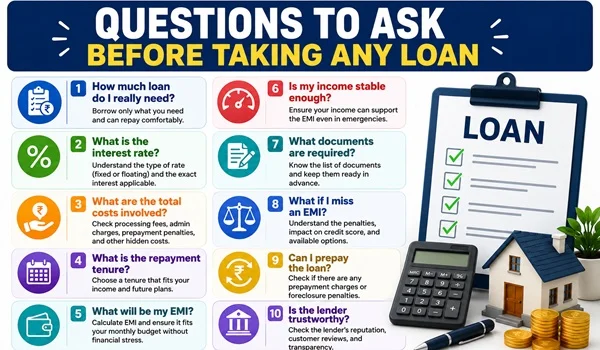
Not all loans are the same. Different lenders may offer different interest rates, repayment terms, fees, and conditions.
Asking questions before borrowing can help you:
- Understand the total cost of the loan.
- Compare different loan offers.
- Avoid hidden charges.
- Choose affordable repayment terms.
- Reduce the risk of financial stress.
- How Much Money Do I Really Need?
Borrow only the amount you actually need.
Ask yourself:
- Can I meet my goal with a smaller loan?
- Will I be able to repay this amount comfortably?
- Am I borrowing for a necessary purpose?
A larger loan usually means paying more interest over time.
- What Is the Interest Rate?
The interest rate affects how much you’ll pay in addition to the borrowed amount.
Ask:
- Is the rate fixed or variable?
- Can it change during the loan term?
- How is the interest calculated?
Even a small difference in the interest rate can affect the total repayment amount.
- What Will My Monthly EMI Be?
Before accepting a loan, find out:
- The monthly EMI amount
- The payment due date
- Whether the EMI fits your monthly budget
Choose an EMI that leaves enough room for your regular expenses and savings.
- What Is the Total Cost of the Loan?
Do not focus only on the monthly payment.
Ask the lender:
- How much will I repay in total?
- How much of that amount is interest?
- Are there any additional costs?
Knowing the total repayment helps you compare loan offers more accurately.
- Are There Any Processing Fees or Other Charges?
Many loans include charges besides interest.
Ask about:
- Processing fees
- Documentation charges
- Administrative fees
- Late payment charges
- Prepayment or foreclosure fees
- Other applicable costs
Request a complete breakdown of all fees before signing.
- What Is the Loan Tenure?
The repayment period affects both your EMI and the total interest.
Generally:
- Shorter tenure means higher EMIs but lower total interest.
- Longer tenure means lower EMIs but higher total interest.
Choose a repayment period that balances affordability and overall cost.
- Can I Repay the Loan Early?
If you expect extra income in the future, ask:
- Can I make partial prepayments?
- Can I close the loan early?
- Is there a prepayment or foreclosure charge?
Early repayment may reduce the total interest paid, depending on your loan terms.
- What Happens If I Miss an EMI?
Understanding the consequences of missed payments is important.
Ask about:
- Late payment charges
- Additional interest
- Collection procedures
- Possible impact on your credit profile
Knowing these terms can help you prepare for unexpected situations.
- Is the Loan Secured or Unsecured?
Ask whether the loan requires collateral.
Secured Loan
Examples include:
- Home loan
- Vehicle loan
These loans usually require an asset as security.
Unsecured Loan
Examples include:
- Personal loan
- Some education loans
These loans generally do not require collateral but may have different eligibility requirements and interest rates.
- What Documents Are Required?
Ask the lender which documents are needed.
Common requirements may include:
- Identity proof
- Address proof
- Income proof
- Bank statements
- Employment details
Submitting complete documents can help avoid processing delays.
- How Long Will Loan Approval and Disbursement Take?
If you need funds by a specific date, ask:
- How long does approval take?
- When will the money be disbursed?
- Are there any steps that could delay the process?
This helps you plan your finances more effectively.
- Will Taking This Loan Affect My Credit?
Ask how the loan may affect your credit profile.
Making timely payments can support a positive credit history, while missed payments may have the opposite effect.
- Is Insurance Required?
Some lenders may require or offer insurance with certain loans.
Ask:
- Is the insurance mandatory or optional?
- What does it cover?
- How much does it cost?
Understand whether the insurance premium is included in your loan.
- Can the Loan Terms Change Later?
Ask whether any of the following may change during the loan period:
- Interest rate
- EMI amount
- Fees
- Repayment schedule
Knowing this helps you avoid unexpected surprises.
- What Happens If I Face Financial Difficulties?
Unexpected situations can affect anyone.
Ask the lender whether they offer options such as:
- Temporary repayment assistance
- Loan restructuring, if available
- Revised repayment schedules
The available options depend on the lender and the type of loan.
Questions to Ask Yourself
Before borrowing, ask yourself:
- Do I truly need this loan?
- Can I comfortably afford the monthly EMI?
- Do I have an emergency fund?
- Have I compared multiple lenders?
- Have I read the loan agreement carefully?
- Do I understand all the charges and conditions?
Answering these questions honestly can help you make a better financial decision.
Common Mistakes to Avoid
Many borrowers make these mistakes:
- Accepting the first loan offer without comparing others.
- Looking only at the interest rate.
- Ignoring processing fees and other charges.
- Borrowing more than necessary.
- Not reading the loan agreement.
- Choosing a long tenure without considering the total interest.
- Assuming they can always repay early without checking for penalties.
Loan Questions Checklist
| Question | Why It Matters |
| How much do I need to borrow? | Prevents unnecessary debt |
| What is the interest rate? | Affects borrowing costs |
| What is the monthly EMI? | Helps plan your budget |
| What is the total repayment amount? | Shows the full loan cost |
| Are there extra fees? | Avoids unexpected expenses |
| Can I repay early? | May help reduce interest costs |
| What happens if I miss a payment? | Helps you understand the risks |
| Is collateral required? | Clarifies your obligations |
| How long is the repayment period? | Affects EMI and total interest |
| Have I compared other lenders? | Helps you find a better deal |
Frequently Asked Questions
Should I compare loan offers before applying?
Yes. Comparing multiple lenders can help you find a loan with suitable interest rates, fees, and repayment terms.
Is the lowest interest rate always the best option?
Not necessarily. Consider the total cost of the loan, including fees, repayment flexibility, and customer service.
Can I negotiate the loan terms?
In some cases, lenders may be willing to discuss interest rates, fees, or repayment terms, especially if you have a strong credit profile.
Why should I read the loan agreement carefully?
The loan agreement explains your rights, responsibilities, repayment conditions, fees, and other important terms. Reading it carefully helps you avoid misunderstandings.
Final Thoughts
Taking a loan is a significant financial commitment, so it’s worth asking the right questions before signing any agreement. Understand the interest rate, total repayment amount, fees, loan tenure, and repayment conditions. Compare offers from different lenders, read the loan agreement carefully, and borrow only what you can comfortably repay. A well-informed decision today can help you manage your loan successfully and avoid financial difficulties in the future.