
Buying an insurance policy can feel confusing if you’re unfamiliar with the terminology. Words like premium, deductible, sum insured, and claim settlement often appear in policy documents, making it difficult for first-time buyers to understand exactly what they’re paying for.
Learning a few basic insurance terms can help you compare policies, understand your coverage, and make better financial decisions. You don’t need to be an insurance expert—knowing the fundamentals is enough to choose a policy with confidence.
In this guide, we’ll explain the most common insurance terms in simple language, along with practical examples.
Why Is It Important to Understand Insurance Terms?
Knowing basic insurance terminology helps you:
- Compare different insurance policies
- Understand what is and isn’t covered
- Avoid misunderstandings during claims
- Choose suitable coverage
- Make informed financial decisions
- Read policy documents more confidently
Understanding these terms before buying a policy can save both time and money.
- Insurance Policy
An insurance policy is the legal agreement between you and the insurance company. It explains the coverage, exclusions, premium, claim process, and other important conditions.
Think of it as the rulebook for your insurance.
Example
You purchase health insurance. The policy document explains which medical expenses are covered, the coverage amount, waiting periods, and claim procedures.
- Policyholder
The policyholder is the person or organization that purchases the insurance policy and is responsible for paying the premium.
The policyholder may or may not be the same person who is insured.
Example
A parent buys a health insurance policy for their child. The parent is the policyholder, while the child is the insured person.
- Insured
The insured is the individual, property, or asset protected by the insurance policy.
Depending on the type of insurance, the insured could be:
- A person
- A vehicle
- A house
- A business
- Valuable property
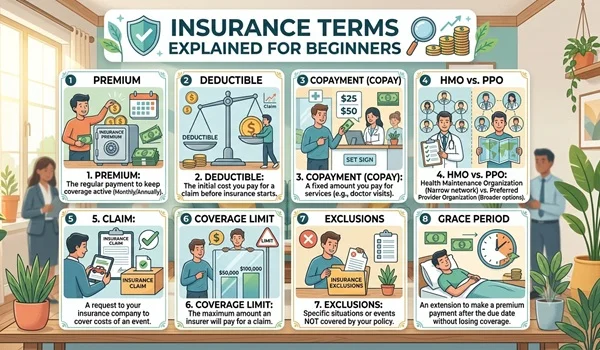
- Insurance Premium
A premium is the amount you pay to keep your insurance policy active.
Premiums may be paid:
- Monthly
- Quarterly
- Semi-annually
- Annually
The amount depends on factors such as the type of insurance, coverage, age, risk profile, and policy features.
Example
If your annual health insurance premium is $900, you’ll pay that amount (or its installment equivalent if allowed) to maintain your coverage.
- Coverage
Coverage refers to the protection provided by an insurance policy.
It explains which events, losses, or expenses the insurer may pay for, subject to the policy terms.
Coverage differs from one policy to another.
- Sum Insured
The sum insured is the maximum amount the insurance company may pay under a policy for covered claims, subject to the policy’s terms and conditions.
Example
If your health insurance has a $100,000 sum insured, eligible claims can be paid up to that limit according to the policy.
- Claim
A claim is a formal request you submit to the insurance company asking for benefits after a covered event occurs.
Examples include:
- Hospitalization
- Vehicle accident
- House fire
- Theft
- Travel emergency
The insurer reviews the claim before deciding whether it is covered under the policy.
- Claim Settlement
Claim settlement is the process of reviewing, approving, and paying an eligible insurance claim.
The insurer checks:
- Policy validity
- Coverage
- Required documents
- Cause of loss
- Policy conditions
If everything meets the policy requirements, the claim is settled according to the terms.
- Deductible
A deductible is the amount you agree to pay yourself before the insurance company contributes toward a covered claim (where applicable).
Example
Suppose:
- Repair cost = $5,000
- Deductible = $500
You pay $500, and the insurer may pay the remaining eligible amount according to the policy.
Policies with higher deductibles often have lower premiums.
- Copayment (Copay)
A copayment is the portion of eligible medical expenses that you agree to pay, while the insurer pays the remaining covered amount.
Example
If your policy has a 20% copayment and an eligible hospital bill is $2,000:
- You pay $400
- The insurer pays the remaining eligible $1,600, subject to the policy terms.
- Waiting Period
A waiting period is the time after purchasing a policy during which certain benefits or conditions are not yet covered.
Waiting periods are common in health insurance for specific illnesses or pre-existing conditions.
Always review the policy details to understand applicable waiting periods.
- Exclusions
Exclusions are situations, treatments, events, or losses that are not covered by the insurance policy.
Examples vary by policy and insurer.
Reading the exclusions section carefully helps prevent surprises during the claim process.
- Nominee
A nominee is the person chosen to receive policy benefits when applicable, such as under many life insurance policies.
Keeping nominee details updated is an important part of managing your policy.
- Beneficiary
A beneficiary is the person or organization entitled to receive insurance benefits according to the policy or applicable law.
Depending on the insurance product, the beneficiary and nominee may not always have the same legal role, so it’s important to understand your policy’s provisions.
- Rider or Add-On Cover
A rider (also called an add-on cover) is an optional benefit that provides additional protection beyond the basic policy.
Examples include:
- Critical illness cover
- Personal accident cover
- Roadside assistance
- Home contents protection
Adding riders usually increases the premium.
- Cashless Claim
A cashless claim allows the insurer to settle eligible expenses directly with a network service provider, such as a hospital or repair facility, according to the policy terms.
The policyholder may still need to pay amounts that are not covered.
- Reimbursement Claim
In a reimbursement claim, you first pay the eligible expenses yourself and later submit the required documents to the insurer for reimbursement according to the policy.
- Network Hospital or Provider
A network hospital or network provider is a healthcare facility or service provider that has an agreement with the insurer.
Using a network provider may simplify the claim process for eligible cashless services.
- Grace Period
A grace period is the extra time allowed after the premium due date to make payment without immediately losing the policy, subject to the insurer’s rules.
The length of the grace period varies by policy.
- Policy Renewal
Policy renewal means extending your insurance coverage for another policy term by paying the required premium before or within the allowed renewal period.
Renewing on time helps avoid a break in coverage.
Quick Insurance Terms Table
| Term | Simple Meaning |
| Insurance Policy | Contract between you and the insurer |
| Policyholder | Person who buys the policy |
| Insured | Person or property protected by the policy |
| Premium | Amount paid for insurance coverage |
| Coverage | Protection offered by the policy |
| Sum Insured | Maximum amount payable for covered claims |
| Claim | Request for insurance benefits |
| Claim Settlement | Review and payment of an eligible claim |
| Deductible | Amount you pay before insurance contributes |
| Copayment | Percentage of eligible costs you pay |
| Waiting Period | Time before certain coverage begins |
| Exclusions | Situations the policy does not cover |
| Nominee | Person designated to receive benefits where applicable |
| Beneficiary | Person entitled to receive policy benefits |
| Rider | Optional additional coverage |
| Cashless Claim | Eligible payment made directly to a network provider |
| Reimbursement Claim | You pay first and later request reimbursement |
| Grace Period | Extra time to pay the premium |
| Policy Renewal | Extending the policy for another term |
Tips for First-Time Insurance Buyers
Before purchasing insurance:
- Read the policy document carefully.
- Understand what is covered and excluded.
- Compare multiple policies.
- Check waiting periods and deductibles.
- Review claim procedures.
- Keep policy documents organized.
- Update nominee information when needed.
- Ask questions if any terms are unclear.
Understanding these basics can help you choose a policy that matches your needs.
Common Mistakes Beginners Make
Avoid these common errors:
Buying Without Reading the Policy
Always understand the coverage before purchasing.
Ignoring Exclusions
Not every situation is covered under every policy.
Choosing Only the Lowest Premium
Lower cost may mean lower coverage or higher out-of-pocket expenses.
Missing Renewal Dates
Late renewal may result in a lapse in coverage.
Not Understanding Deductibles
A lower premium isn’t always better if the deductible is more than you can comfortably afford.
Frequently Asked Questions
What is the easiest insurance term to understand first?
Start with premium, coverage, claim, and sum insured. These four terms form the foundation of most insurance policies.
What is the difference between a premium and a claim?
A premium is the amount you pay to keep your insurance active. A claim is a request you make to receive benefits after a covered event occurs.
Why should I read the exclusions section?
Exclusions explain what your policy does not cover. Understanding them helps you avoid unexpected claim rejections.
What happens if I miss a premium payment?
Many policies provide a grace period, but the rules vary by insurer. If the premium is not paid within the allowed time, the policy may lapse.
Are all insurance terms the same for every type of insurance?
Many basic terms, such as premium and claim, are common across insurance products. However, some terms and conditions vary depending on whether the policy covers health, life, motor, travel, home, or business insurance.
Final Thoughts
Insurance doesn’t have to be difficult to understand. Learning a few essential terms can make it much easier to compare policies, understand your rights and responsibilities, and make informed financial decisions. Whether you’re buying health, life, motor, or home insurance, understanding the language of insurance helps you choose suitable coverage with greater confidence.
Remember that every insurance policy is different. Always read the policy documents carefully, ask questions when needed, and focus on understanding both the benefits and the limitations before making your final decision.