
Problem-solving is one of the most valuable skills in both personal and professional life. Every day, we face challenges that require us to think clearly, make decisions, and find practical solutions. Whether you’re a student, employee, business owner, or job seeker, strong problem-solving skills can help you handle difficult situations with confidence.
The good news is that problem-solving is a skill you can develop through practice and experience.
What Are Problem-Solving Skills?
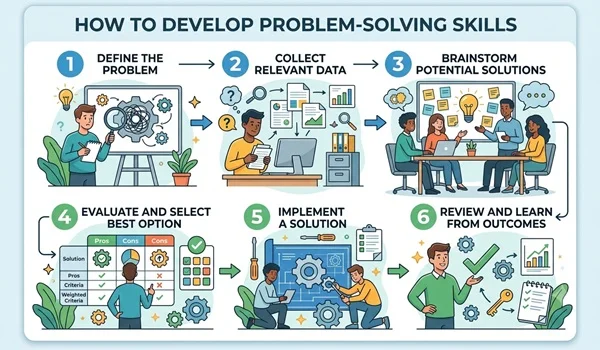
Problem-solving skills are the ability to:
- Identify a problem.
- Understand its causes.
- Think of possible solutions.
- Choose the best option.
- Take action.
- Review the results and learn from the experience.
These skills help you make informed decisions instead of reacting without a plan.
Why Problem-Solving Skills Are Important
Strong problem-solving skills can help you:
- Make better decisions.
- Handle challenges with confidence.
- Improve productivity.
- Reduce stress during difficult situations.
- Build leadership qualities.
- Increase career opportunities.
These skills are valuable in school, the workplace, business, and everyday life.
- Clearly Identify the Problem
Before finding a solution, make sure you understand the actual problem.
Ask yourself:
- What exactly is happening?
- When did the problem begin?
- Who is affected?
- What is the main cause?
A clear understanding prevents you from solving the wrong problem.
- Gather Relevant Information
Collect facts before making decisions.
Look for:
- Available data.
- Past experiences.
- Opinions from reliable sources.
- Possible constraints.
Avoid making decisions based on assumptions alone.
- Break the Problem into Smaller Parts
Large problems often become easier to solve when divided into smaller tasks.
For example:
- Identify the main issue.
- List contributing factors.
- Solve one part at a time.
- Monitor progress after each step.
This approach makes complex problems more manageable.
- Think of Multiple Solutions
Don’t stop after the first idea.
Brainstorm several possible solutions by asking:
- What are my options?
- Is there another approach?
- What would happen if I tried a different method?
Having multiple options helps you choose the most suitable solution.
- Evaluate the Pros and Cons
Before taking action, compare your options.
Consider:
- Benefits.
- Risks.
- Time required.
- Cost.
- Long-term impact.
Choosing a well-considered solution often leads to better results.
- Make a Decision
After reviewing your options, choose the solution that best fits the situation.
Avoid delaying decisions unnecessarily.
A timely, informed decision is usually more effective than waiting for a perfect solution.
- Take Action
A solution only works if it is put into practice.
Create a simple action plan by deciding:
- What needs to be done?
- Who will do it?
- When should it be completed?
- What resources are needed?
Taking action turns ideas into results.
- Review the Results
After implementing your solution, evaluate the outcome.
Ask yourself:
- Did the solution work?
- What went well?
- What could be improved?
- What did I learn?
Reviewing results helps improve future problem-solving.
- Improve Your Critical Thinking
Critical thinking helps you analyze situations objectively.
Practice by:
- Asking thoughtful questions.
- Looking for evidence.
- Considering different viewpoints.
- Avoiding quick assumptions.
- Focusing on facts rather than emotions.
Strong critical thinking supports better decision-making.
- Learn from Mistakes
Mistakes are valuable learning opportunities.
Instead of becoming discouraged:
- Identify what went wrong.
- Understand why it happened.
- Adjust your approach.
- Apply the lesson in future situations.
Learning from experience strengthens your problem-solving abilities.
- Improve Your Creativity
Creative thinking can lead to innovative solutions.
Try to:
- Brainstorm without judging ideas immediately.
- Look at problems from different perspectives.
- Ask “What if?” questions.
- Explore alternative approaches.
Creativity and logical thinking often work well together.
- Strengthen Your Communication Skills
Many problems require teamwork.
Good communication helps you:
- Explain issues clearly.
- Listen to different opinions.
- Ask useful questions.
- Share ideas effectively.
- Work toward shared solutions.
Clear communication improves collaboration.
- Stay Calm Under Pressure
Stress can make problems seem larger than they are.
When facing challenges:
- Take a moment to think.
- Focus on facts.
- Break the task into smaller steps.
- Avoid making rushed decisions.
A calm mindset often leads to better solutions.
- Seek Feedback and Advice
You don’t have to solve every problem alone.
Ask for guidance from:
- Teachers.
- Mentors.
- Managers.
- Experienced colleagues.
- Trusted friends or family members.
Different perspectives may reveal solutions you hadn’t considered.
- Practice Every Day
Problem-solving improves with regular practice.
Look for opportunities to:
- Solve puzzles or logic games.
- Analyze real-life situations.
- Participate in group discussions.
- Reflect on daily challenges.
- Practice making informed decisions.
Small daily exercises build long-term confidence.
Simple Steps to Solve Any Problem
Use this five-step process:
- Define the problem clearly.
- Gather relevant information.
- Generate possible solutions.
- Choose and implement the best option.
- Review the outcome and learn from it.
Following a structured process helps you stay organized and focused.
Common Mistakes to Avoid
Many people struggle with problem-solving because they:
- Jump to conclusions.
- Ignore important facts.
- Focus only on one solution.
- Avoid asking for help.
- Let emotions control decisions.
- Fail to review the results.
Recognizing these habits can help you improve.
Tips to Build Better Problem-Solving Skills
Follow these practical habits:
- Stay curious.
- Keep learning new skills.
- Ask questions before making decisions.
- Practice critical thinking.
- Listen to different viewpoints.
- Stay organized.
- Learn from both successes and failures.
Consistent practice makes problem-solving easier over time.
Problem-Solving Skills Checklist
| Skill | Benefit |
| Problem identification | Understands the real issue |
| Information gathering | Supports informed decisions |
| Critical thinking | Improves analysis |
| Creative thinking | Generates new ideas |
| Decision-making | Chooses effective solutions |
| Communication | Improves teamwork |
| Adaptability | Handles changing situations |
| Reviewing outcomes | Encourages continuous improvement |
Frequently Asked Questions
Can problem-solving skills be learned?
Yes. Problem-solving is a skill that improves through practice, experience, and learning from both successes and mistakes.
Why is critical thinking important for problem-solving?
Critical thinking helps you evaluate information objectively, consider different options, and make logical decisions based on evidence rather than assumptions.
How can students improve problem-solving skills?
Students can improve by solving practice questions, working on projects, participating in discussions, asking questions, and reflecting on how they solved challenges.
Why do employers value problem-solving skills?
Employers appreciate people who can identify issues, think independently, make informed decisions, and contribute practical solutions that improve productivity and teamwork.
Final Thoughts
Problem-solving is an essential life and career skill that helps you overcome challenges with confidence. By identifying problems clearly, gathering information, thinking critically, considering multiple solutions, taking action, and learning from the results, you can steadily improve your ability to handle difficult situations. With regular practice and a willingness to learn, strong problem-solving skills can benefit you in school, the workplace, and everyday life.